

AI prompts are the backbone of tools like ChatGPT, Claude, and Perplexity-but most people still use them incorrectly.
Whether you’re creating SEO content, running marketing campaigns, or building a blog, the quality of your results depends entirely on how well you write your prompts.
In simple terms, AI prompts are structured instructions that guide AI tools to generate accurate, relevant, and high-quality outputs.
This complete guide will show you how to write better AI prompts-from basic concepts to advanced frameworks-along with ready-to-use templates to improve your workflow instantly.
What Are AI Prompts and Why They Matter
An AI prompt is any instruction, question, or description you give to an AI system. Think of it as a conversation starter that tells the AI exactly what you need.
Here’s why prompts matter:
- Quality In = Quality Out: Vague prompts produce generic results. Specific prompts deliver actionable content.
- Time Savings: Well-crafted prompts eliminate endless back-and-forth revisions.
- Consistency: Structured prompts ensure repeatable, reliable outputs across your team.
- Cost Efficiency: Better prompts mean fewer iterations, saving both time and API costs.
According to recent data, 64% of marketing professionals now use AI in their daily workflows. Those who master prompt engineering save hours every week and produce better content faster.
How Prompts Affect AI Output Quality?
AI language models like ChatGPT don’t “understand” your intent the way humans do – they recognize patterns in language. Your prompt is the blueprint that guides their response.
What Makes a Prompt Effective?
Every strong prompt needs three core elements:
-
Clear Input
- Assign the AI a specific role (e.g., “You are an SEO strategist”)
- Define the task with precision
- Outline the data or context you’re providing
-
Context
- Background information helps AI understand your goals
- Industry specifics, target audience, and business objectives matter
- Include constraints like word count, tone, or format
-
Constraints
- Set boundaries: style guides, content structure, brand voice
- Specify what to avoid (jargon, certain topics, formats)
- Define success criteria for the output
Example of a weak prompt:
“Write about SEO.”
Example of a strong prompt:
“You are an SEO content strategist. Write a 300-word introduction to technical SEO for small business owners with no prior SEO knowledge. Use simple language, avoid jargon, and include one practical tip they can implement today.”
The difference? The second prompt produces usable content on the first try.
Types of AI Prompts
Understanding different prompt types helps you choose the right approach for each task.
1. Instructional Prompts
Direct commands that tell AI exactly what to do.
Example:
“Create a list of 10 blog post ideas about sustainable fashion for Gen Z audiences.”
Best for: Quick tasks, brainstorming, list generation
2. Contextual Prompts
Include background information to guide the AI’s understanding.
Example:
“Our SaaS company targets mid-sized B2B tech firms. We’ve seen a 30% drop in email open rates. Analyze potential causes and suggest three solutions.”
Best for: Strategic advice, problem-solving, analysis
3. Role-Based Prompts
Assign the AI a specific expertise or perspective.
Example:
“You are a senior email marketing specialist with 10 years of experience in e-commerce. Review this email subject line and suggest improvements.”
Best for: Expert-level advice, specialized content, professional tone
4. Step-by-Step Prompts
Break complex tasks into sequential instructions.
Example:
“First, identify the main keywords in this article. Second, analyze the search intent. Third, suggest three H2 headings that match that intent.”
Best for: Complex workflows, quality control, detailed analysis
5. Few-Shot Prompts
Provide examples of what you want to guide the AI.
Example:
“Write product descriptions in this style:
Example 1: ‘Soft cashmere sweater that feels like a hug -perfect for cozy evenings.’
Example 2: ‘Sleek wireless earbuds with crystal-clear sound- your commute just got better.’
Now write one for: organic cotton t-shirt.”
Best for: Matching specific styles, brand voice consistency
6. Constraint-Based Prompts
Set strict parameters to control the output.
Example:
“Write a 50-word meta description for our project management software landing page. Include the keyword ‘team collaboration tools’ and a call-to-action. Stay under 155 characters.”
Best for: SEO content, character-limited copy, formatted output
Prompt Frameworks Marketers Can Use
Frameworks act as templates that organize your instructions for consistent, high-quality results. Here are the most effective ones:
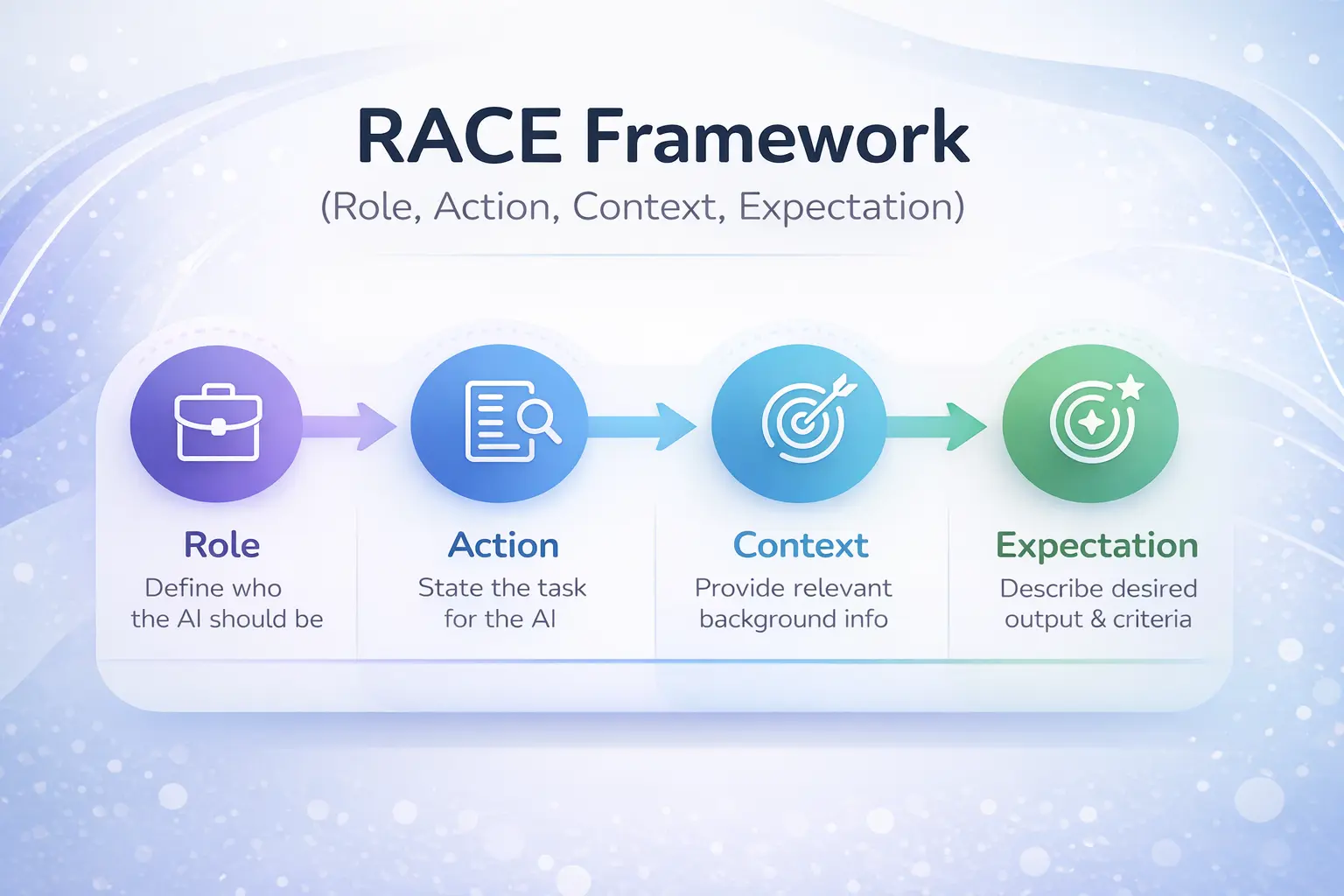
RACE Framework (Role, Action, Context, Expectation)
When to use: General marketing tasks requiring tailored outputs
Structure:
- Role: Define who the AI should be
- Action: State the task
- Context: Provide background
- Expectation: Describe the desired outcome
Template:
- Role: You are a [specific role with expertise in X]
- Action: [Create/analyze/write/develop] a [specific deliverable]
- Context: [Background: audience, goals, constraints]
- Expectation: [Format, length, tone, and success criteria]
Example:
Role: You are a B2B SaaS content strategist specializing in demand generation.
Action: Create a content outline for a whitepaper on sales automation.
Context: Target audience is VP-level sales leaders at companies with 100-500 employees. They’re evaluating automation tools but concerned about implementation complexity.
Expectation: Provide 5-7 main sections with 3-4 subsections each. Include suggested data points to include and CTAs for each section.
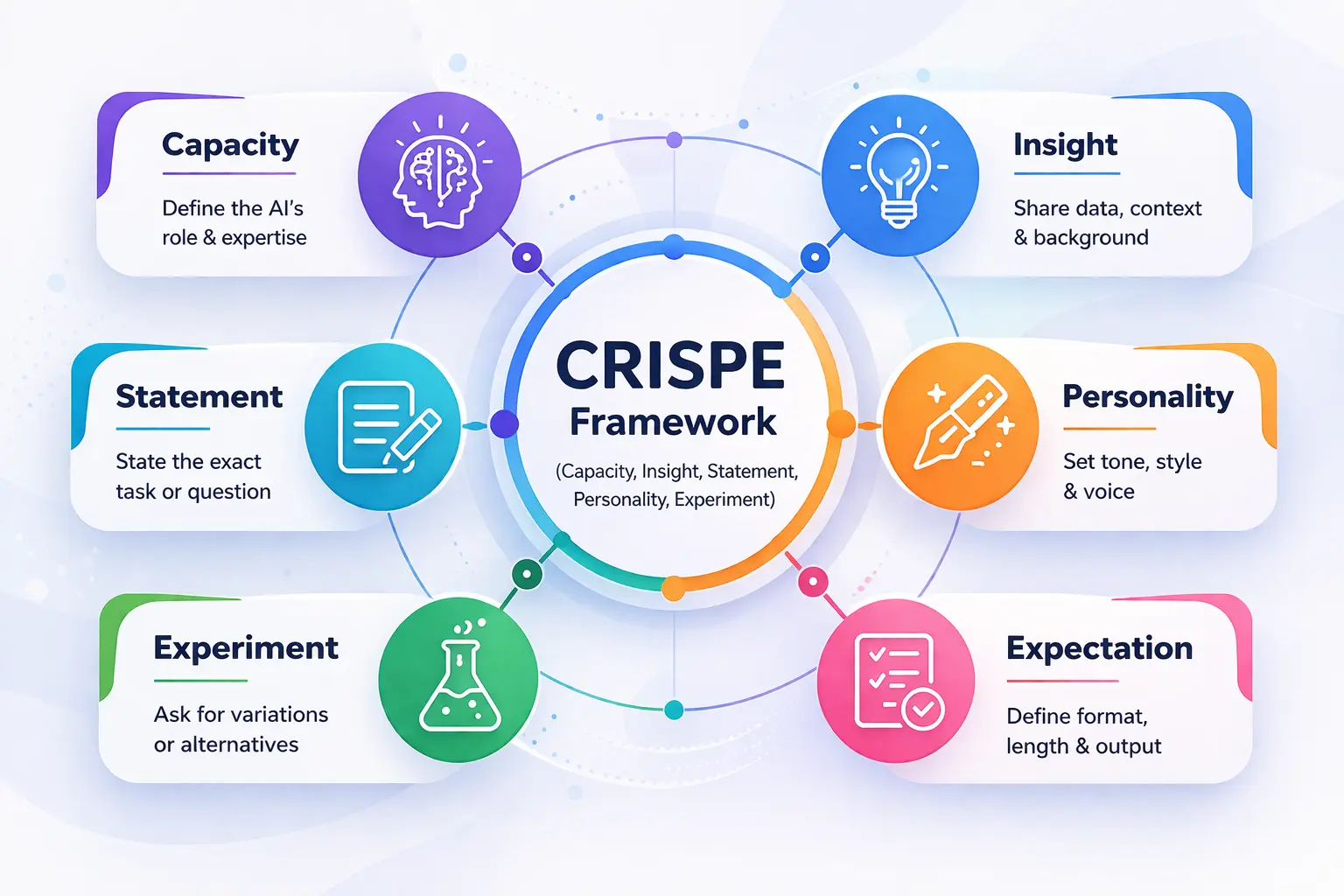
CRISPE Framework (Capacity, Insight, Statement, Personality, Experiment)
When to use: Creative campaigns, testing variations, exploring different angles
Structure:
- Capacity/Role: Assign expertise
- Insight: Share background data
- Statement: Define the task
- Personality: Set tone and style
- Experiment: Request multiple variations
Template:
- Capacity: You are a [role with specific expertise]
- Insight: [Market context, audience behavior, current challenges]
- Statement: [Specific task to accomplish]
- Personality: [Tone: professional/casual/persuasive/educational]
- Experiment: Provide [X] variations testing [different angles/formats/hooks]
Example:
Capacity: You are a social media strategist for B2B tech companies.
Insight: Our LinkedIn posts get impressions but low engagement. Our audience is CTOs and engineering leaders who value technical depth over marketing fluff.
Statement: Create LinkedIn post concepts that drive comments and shares.
Personality: Professional but conversational. Lead with insight, not promotion. Use data when possible.
Experiment: Provide 3 distinct approaches: (1) controversial opinion, (2) case study breakdown, (3) myth-busting format. Include hook, body structure, and engagement questions for each.
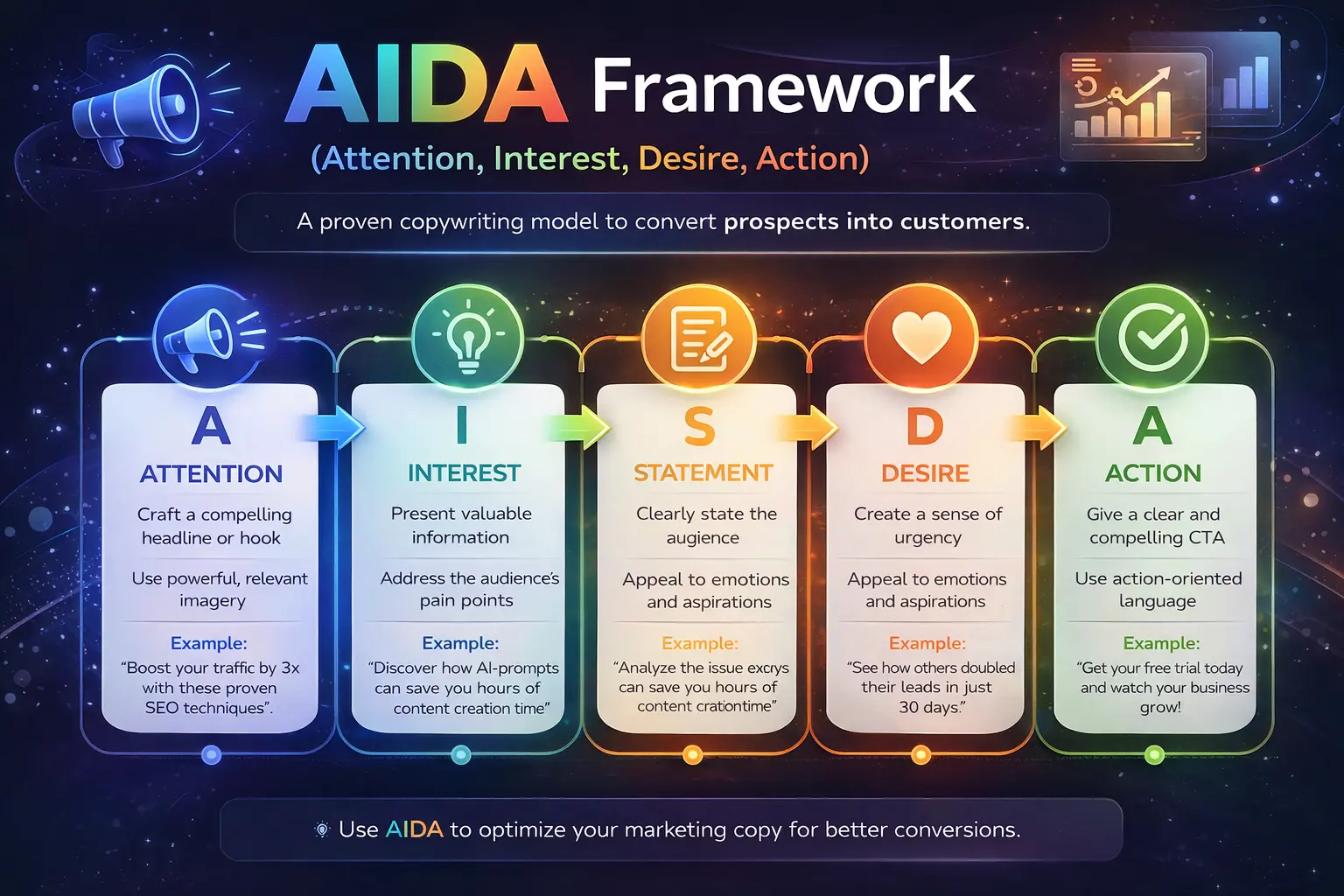
AIDA Framework (Attention, Interest, Desire, Action)
When to use: Persuasive copy, landing pages, email campaigns, ads
Structure:
- Attention: Hook that grabs focus
- Interest: Build engagement
- Desire: Create want
- Action: Clear next step
Template:
- Attention: [Opening that addresses pain point or curiosity]
- Interest: [Facts, stats, or scenarios that deepen engagement]
- Desire: [Benefits and transformation the solution provides]
- Action: [Specific CTA with clear value proposition]
Example:
Attention: Write a headline for LinkedIn ads targeting RevOps leaders struggling with manual commission calculations.
Interest: Use real data showing that 60% of companies still use error-prone spreadsheets for sales commissions.
Desire: Explain how automation eliminates payout disputes and saves 15+ hours per month.
Action: CTA to “See how it works—book a 15-minute demo” or download the “Commission Audit Checklist.”
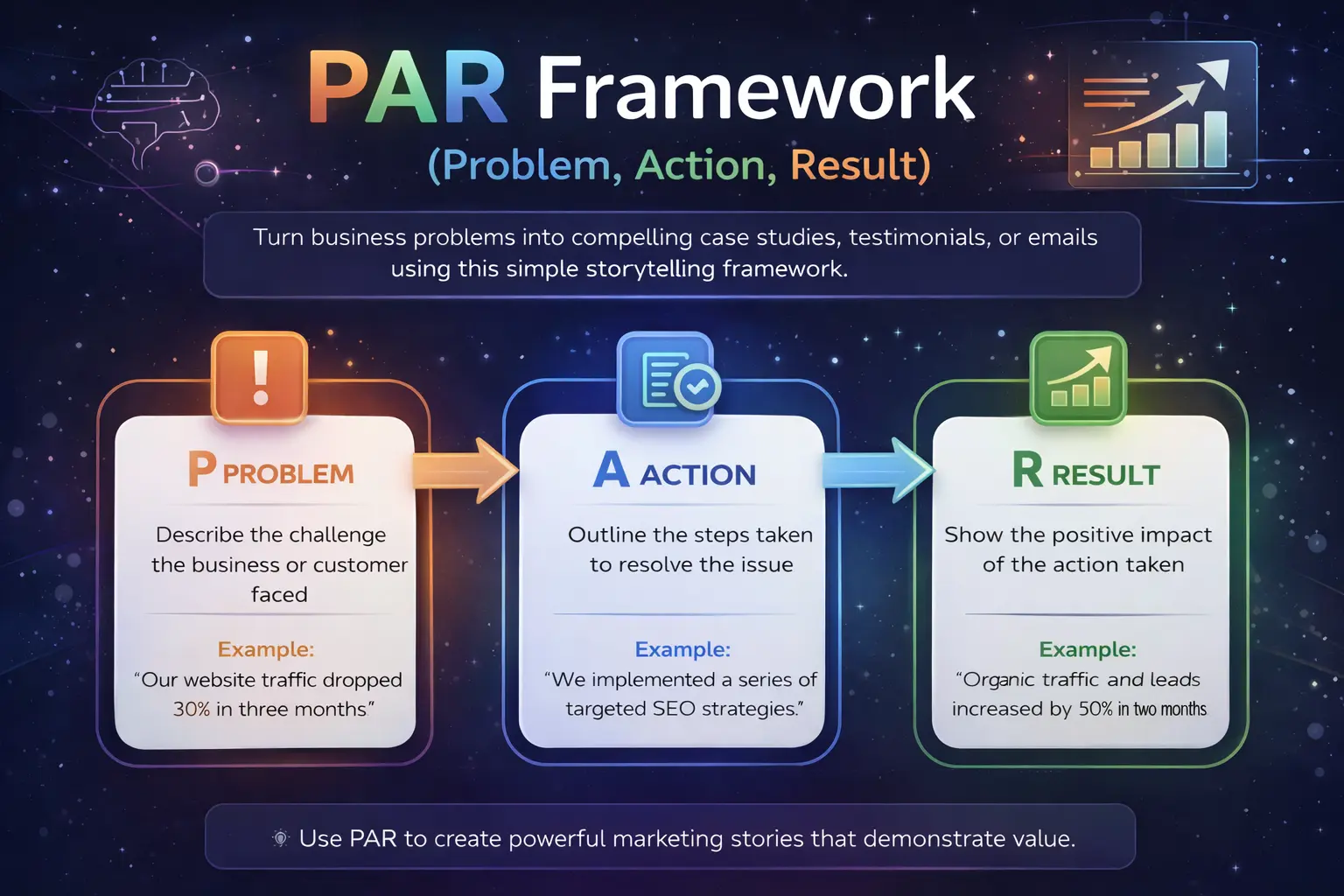
PAR Framework (Problem, Action, Result)
When to use: Problem-solving, optimization tasks, performance improvements
Template:
- Problem: [Current challenge or pain point]
- Action: [Specific steps to address it]
- Result: [Expected outcome with metrics]
Example:
Problem: Our blog posts rank on page 2 of Google but never break into the top 10.
Action: Audit the top 3 ranking articles for our target keyword “email marketing automation.” Identify common elements we’re missing (depth, structure, multimedia, backlinks). Suggest specific improvements to our existing article.
Result: Achieve page 1 ranking within 90 days by matching search intent and content depth of top competitors.
AI Prompts for SEO
Keyword Research Prompts
- Long-Tail Keyword Generator
Act as an SEO specialist. Generate 20 long-tail keyword variations for the seed keyword “[your keyword]” that have informational search intent. Group them by subtopic and include estimated search difficulty (low/medium/high) based on keyword structure.
- Search Intent Analyzer
Analyze these 5 keywords: [list keywords]
For each, identify:
- Primary search intent (informational/navigational/transactional/commercial)
- User’s likely question or goal
- Content format that best matches intent (guide/comparison/product page/tool)
- Keyword Clustering
You are an SEO strategist. I have this list of 50 keywords [paste list]. Cluster them into thematic groups that could each be targeted by a single piece of content. Name each cluster, identify the primary keyword, and suggest content type.
Content Brief Generation
Create a comprehensive content brief for an article targeting the keyword “[target keyword].”
Include:
- Primary and secondary keywords
- Search intent analysis
- Target word count (based on top 10 competitors)
- Required H2/H3 structure
- Questions to answer (from People Also Ask)
- Unique angle to differentiate from competitors
- Internal linking opportunities
- Recommended multimedia elements
Analyze the current top 5 ranking pages: [list URLs]
Meta Tag Optimization
You are an SEO copywriter. Create 5 variations of meta titles and descriptions for this page:
- URL: [your URL]
- Target keyword: [keyword]
- Page topic: [brief description]
Requirements:
- Meta titles: Under 60 characters, include keyword naturally
- Meta descriptions: 150-155 characters, include keyword and CTA
- Make each variation test different emotional triggers (urgency, curiosity, benefit-driven, authority-based, problem-focused)
Internal Linking Strategy
Act as a technical SEO consultant. I have these existing articles on my site: [list article titles/URLs]
Suggest an internal linking strategy:
- Identify content clusters (related topic groups)
- Recommend which articles should link to which
- Suggest specific anchor text for each link
- Identify any orphan pages (content with few internal links)
- Propose new content to fill gaps and strengthen clusters
SERP Analysis Prompt
Analyze the top 10 Google results for “[target keyword]” and provide:
- Dominant content format (listicle/how-to/comparison/tool/video)
- Average word count
- Common H2/H3 structures
- SERP features present (featured snippet/PAA/video carousel/local pack)
- E-E-A-T signals used (author bios/credentials/citations)
- Content gaps—what’s missing that we could cover
- Unique angle recommendation to outrank current results
AI Prompts for Bloggers
Content Ideation
- Trending Topic Generator
You are a content strategist for a [niche] blog. Generate 15 blog post ideas that:
- Address current trends in [industry]
- Have strong search potential
- Match these reader pain points: [list 3-5 pain points]
- Range from beginner to advanced difficulty
For each idea, include:
- Working title
- Target keyword
- Why it’s timely/relevant
- Unique angle
- Content Gap Finder
I run a blog about [topic]. My main competitors are: [list 3-5 competitor URLs]
Analyze their content and identify:
- Topics they cover that I don’t
- Topics where my coverage is weaker
- High-opportunity gaps where competition is low but interest is high
- Suggest 10 article ideas that fill these gaps
Outline Creation
Create a comprehensive blog post outline for: “[article topic]”
- Target audience: [describe audience]
- Target keyword: [keyword]
- Word count goal: [number] words
Structure:
- Attention-grabbing introduction (include hook, problem, promise)
- 5-7 H2 sections with 2-4 H3 subsections each
- For each section, note:
- Key points to cover
- Examples or data to include
- Transition to next section
- Conclusion with actionable takeaways
- FAQ section (5-7 questions from PAA)
Make the outline flow logically from problem → understanding → solution → implementation.
Storytelling Enhancement
You are a narrative copywriter. Transform this informational content into an engaging story:
[Paste your draft content]
Add:
- Personal anecdote or case study as opening hook
- Character development (make the reader the hero)
- Conflict and resolution framework
- Emotional connection points
- Vivid, specific examples instead of generic statements
- Conversational transitions between sections
Keep all factual information intact but make it more memorable and engaging.
Editing and Polish
- Readability Improver
Act as a senior editor. Improve the readability of this content for [target audience]:
[Paste content]
Tasks:
- Break up long paragraphs (max 3-4 sentences each)
- Simplify complex sentences
- Replace jargon with plain language (or explain technical terms)
- Add transition words for better flow
- Vary sentence length for rhythm
- Highlight key takeaways with bullet points
- Suggest where to add subheadings
- SEO Content Optimizer
Optimize this blog post for SEO without keyword stuffing:
- Target keyword: [keyword]
- Secondary keywords: [list]
- Current draft: [paste content]
Improvements needed:
- Ensure keyword appears naturally in H1, first paragraph, one H2, and conclusion
- Add semantic/LSI keywords where relevant
- Improve internal linking opportunities (suggest specific anchor text)
- Optimize for featured snippet (add concise answer near top)
- Enhance E-E-A-T signals (suggest where to add expertise/credentials)
Content Repurposing
I have this blog post: [paste URL or content]
Repurpose it into:
- 5 LinkedIn posts (each highlighting one key insight)
- Twitter thread (10-12 tweets with hooks)
- Email newsletter (with compelling subject line)
- YouTube video script outline
- Instagram carousel (6-8 slides)
For each format:
- Adapt tone/length appropriately
- Maintain core message
- Include platform-specific engagement tactics
AI Prompts for Marketing
Ad Copy Creation
- Google Ads Headlines
Create 15 Google Ads headlines for [product/service]:
- Target audience: [describe]
- Key benefit: [main value proposition]
- Target keyword: [keyword]
Requirements:
- Maximum 30 characters each
- Include keyword in 5 of them
- Test these angles:
- Benefit-driven (5 headlines)
- Problem-solving (5 headlines)
- Social proof/authority (5 headlines)
- Make each unique and action-oriented
- Facebook Ad Variations
You are a direct response copywriter. Write 3 Facebook ad variations for [product]:
- Campaign goal: [awareness/consideration/conversion]
- Audience: [demographics and psychographics]
- Key pain point: [specific problem]
- Unique selling point: [what makes you different]
For each variation, provide:
- Primary text (125-150 words)
- Headline (5 words max)
- Description (under 30 characters)
- CTA button text
Test these frameworks:
- Problem-Agitation-Solution
- Before-After-Bridge
- Storytelling (customer journey)
Email Marketing
- Welcome Email Sequence
Create a 5-email welcome sequence for new subscribers to our [industry] newsletter:
- Brand voice: [describe tone]
- Audience: [describe subscribers]
- Goal: Build trust and move toward [conversion goal]
For each email, provide:
- Subject line (3 variations)
- Preview text
- Email body (200-300 words)
- CTA
- Timing (e.g., immediately, 2 days later, etc.)
- Email 1: Welcome + set expectations
- Email 2: Deliver promised value/resource
- Email 3: Educational content + soft pitch
- Email 4: Social proof + case study
- Email 5: Direct offer with urgency
- Re-engagement Campaign
Write an email to re-engage subscribers who haven’t opened in 90+ days:
- Subject line: [Create 5 curiosity-driven options]
- Preview text: [Under 50 characters]
- Body: [200-250 words]
Include:
- Acknowledge their absence (no guilt trip)
- Remind them why they subscribed
- Highlight what’s new/improved
- Offer an incentive to stay
- Clear re-engagement CTA
- Easy unsubscribe option (respecting their choice)
Social Media Content
- LinkedIn Thought Leadership
You are a LinkedIn ghostwriter for executives. Write a post about [topic]:
- Author persona: [title, industry, expertise]
- Goal: Position as thought leader + drive engagement
- Length: 150-200 words
Structure:
- Hook (first line must stop the scroll)
- Personal insight or contrarian opinion
- Data point or example
- Actionable takeaway
- Engagement question
Make it conversational. Use short paragraphs. Add strategic line breaks for readability.
- Twitter Thread Creator
Convert this blog post/idea into a Twitter thread:
- Topic: [your topic]
- Main points: [list 3-5 key points]
Requirements:
- 8-12 tweets total
- First tweet: Hook that makes people want to read more
- Middle tweets: Break down key insights (one per tweet)
- Final tweet: Summary + CTA
- Add numbers/bullets where relevant
- Keep each under 280 characters
- Include strategic emoji for visual breaks
Landing Page Copy
Write conversion-focused copy for a landing page:
- Product/Service: [what you’re selling]
- Target audience: [who it’s for]
- Main benefit: [primary value proposition]
- Objections: [list 3-4 common hesitations]
Structure needed:
- Hero Section:
- Headline (10 words max, benefit-driven)
- Subheadline (clarify what it is)
- Primary CTA button text
- Problem Section:
- Describe the pain point (2-3 sentences)
- Amplify the cost of inaction
- Solution Section:
- How your product solves it
- 3-5 key features with benefit-focused descriptions
- Social Proof:
- Testimonial framework (what to highlight)
- Trust signals to emphasize
- Final CTA:
- Risk-reversal statement
- Urgency/scarcity element
- Button text
Use short paragraphs, bullet points, and persuasive language without hype.
Common Mistakes When Writing Prompts
Even experienced users make these errors—here’s how to avoid them:
1. Being Too Vague
❌ Bad: “Write something about marketing.”
✅ Good: “Write a 500-word guide to email segmentation for e-commerce brands, targeting marketing managers with 2-5 years of experience.”
2. Information Overload
❌ Bad: Dumping 10 different requirements, 5 examples, 3 URL references, and multiple conflicting instructions in one prompt.
✅ Good: Break complex tasks into steps. Get the outline first, then refine each section.
3. Assuming AI Knows Your Context
❌ Bad: “Make it better.”
✅ Good: “Rewrite this paragraph to be more concise, use active voice, and target B2B decision-makers rather than general consumers.”
4. Not Specifying Format
❌ Bad: “Give me keyword ideas.”
✅ Good: “Provide 20 keyword ideas in a table with columns for keyword, search intent, difficulty level, and content type recommendation.”
5. Forgetting to Assign a Role
❌ Bad: “Write an article about SEO.”
✅ Good: “You are an SEO consultant with 10 years of experience. Write an article about technical SEO for small business owners.”
6. No Constraints or Boundaries
❌ Bad: “Create social media content.”
✅ Good: “Create 5 LinkedIn posts, each 150 words, professional tone, focused on B2B SaaS marketing trends, with engagement questions at the end.”
7. Ignoring Iteration
Don’t expect perfection on the first try. Treat AI prompting as a conversation:
- Get initial output
- Identify what needs improvement
- Refine your prompt
- Request specific changes
Prompt Optimization Tips
1. Use Chain-of-Thought Prompting
For complex tasks, ask AI to “think step-by-step”:
Before writing the content, first:
- Analyze the target audience’s pain points
- Identify the primary search intent
- Outline the key arguments
- Then write the article based on this analysis
This produces more thoughtful, logical outputs.
2. Test Different Temperature Settings
Some AI tools let you adjust “creativity” (temperature):
- Lower (0-0.3): Factual, consistent, predictable—good for data, SEO, technical content
- Higher (0.7-1.0): Creative, varied, exploratory—good for brainstorming, storytelling, ads
3. Provide Examples (Few-Shot Learning)
Show the AI what you want:
Write product descriptions in this style:
Example 1: “Buttery-soft leggings that move with you—yoga class to coffee run approved.”
Example 2: “Oversized hoodie in vintage washed cotton—your new weekend uniform.”
Now write one for: ceramic coffee mug
4. Use Negative Instructions
Tell AI what NOT to do:
Write a blog introduction about productivity apps.
Do NOT:
- Use cliches like “in today’s fast-paced world”
- Make generic statements
- Include fluff or filler sentences
- Use corporate jargon
5. Iterate with Follow-Up Prompts
Don’t restart—build on previous responses:
First prompt: “Outline a blog post about content marketing ROI”
Follow-up: “Expand section 3 with specific metrics to track”
Next: “Add a case study example to section 4”
Finally: “Rewrite the introduction to be more engaging”
6. Create Reusable Prompt Templates
Save your best prompts and customize variables:
You are a [ROLE] with expertise in [EXPERTISE AREA].
Create a [CONTENT TYPE] about [TOPIC] for [TARGET AUDIENCE].
Requirements:
- Tone: [TONE]
- Length: [WORD COUNT]
- Format: [STRUCTURE]
- Include: [SPECIFIC ELEMENTS]
- Avoid: [THINGS TO EXCLUDE]
- Context: [BACKGROUND INFORMATION]
Fill in the bracketed sections for each new project.
Conclusion
AI prompts are your unlock code to work smarter, not harder. Whether you’re optimizing for search engines, creating blog content, or running marketing campaigns, the quality of your results depends on how well you communicate with AI.
Key takeaways:
- Structure matters: Use proven frameworks (RACE, CRISPE, AIDA) to organize your prompts
- Be specific: Clear roles, detailed context, and defined expectations produce better outputs
- Iterate and refine: Don’t expect perfection on the first try—treat prompting as a conversation
- Avoid common mistakes: Vagueness, information overload, and missing context hurt your results
- Save time with templates: Create reusable prompt structures for repeated tasks
- Test and optimize: Experiment with different approaches to find what works best for your workflow
The marketers, bloggers, and SEO professionals who master prompt engineering will work faster, create better content, and stay ahead in an AI-driven landscape.
Start with one framework from this guide, test it on your next project, and refine from there. Within weeks, you’ll develop an intuition for crafting prompts that consistently deliver exactly what you need.