


Selling online today is no longer about simply uploading products and waiting for orders. Marketplaces such as Amazon, Flipkart, Nykaa, Walmart, and quick-commerce platforms operate on complex algorithms, strict compliance rules, and intense competition. Every pricing change, product image, delivery metric, and customer review influences how visible your products are.
This is why marketplace management services have become essential for brands that want to grow sustainably. Whether you are a beginner launching your first product or a business expanding into multiple platforms, professional ecommerce marketplace management helps you scale faster while avoiding costly mistakes.
This guide explains everything about online marketplace management, how it works, what it includes, and how to choose the right marketplace management company – in simple language that anyone can understand.
What Is Marketplace Management?
Marketplace management refers to managing every operational and growth activity of your seller account across. across Marketplace/ecommerce platforms. It goes beyond simply receiving orders and shipping products. Good marketplace account management ensures that your products are discoverable, competitive, compliant, and profitable.
In practical terms, this includes:
- Product listings are created and optimized with clear titles, helpful descriptions, and quality images so customers can easily find and trust your products in search results.
- Pricing and offers are monitored regularly to stay competitive in the market while protecting healthy profit margins.
- Inventory and order flow are managed carefully to prevent stockouts, overselling, and delivery delays that can harm seller ratings.
- Advertising campaigns are optimized continuously so your marketing budget generates real sales instead of wasted clicks.
- Customer reviews and ratings are monitored and responded to professionally, helping build long-term brand trust and credibility.
- Marketplace policies and compliance requirements are tracked closely to avoid listing suppression or account suspension.
- Sales performance and profitability reports help sellers understand what is working and where improvements are needed.
As sellers expand to more platforms, structured online marketplace management becomes critical to maintain accuracy and scale efficiently.
What Are Marketplace Management Services?
Marketplace management services involve outsourcing your marketplace operations to specialists who manage both execution and optimization. A professional marketplace management company does not just manage tasks — they actively drive growth, performance stability, and profitability.
Here’s what a professional team typically handles:
- Seller accounts are set up correctly from the beginning, including documentation, tax registration, and platform compliance to avoid onboarding issues.
- Product catalogs are structured and optimized so listings rank better in marketplace searches and convert more visitors into buyers.
- Inventory levels are synchronized across platforms so sellers never lose sales due to stock mismatches or overselling.
- Advertising campaigns are monitored daily to control costs while increasing visibility and conversions.
- Pricing is tracked against competitors to maintain a strong market position without unnecessary discounting.
- Orders, returns, and customer interactions are handled smoothly to maintain high service quality and platform ratings.
- Regular performance reporting helps guide data-driven growth decisions and expansion strategies.
This approach enables brands to focus on business growth instead of daily operational firefighting.
Marketplace Selling vs Marketplace Management
Selling on a marketplace means handling everything manually. Marketplace management introduces systems, automation, and strategy. Instead of reacting to problems, sellers operate proactively and scale predictably.
Why E-commerce Marketplace Management Is Becoming Essential?
The marketplace ecosystem has become more competitive and technologically driven.
- With more sellers entering marketplaces every year, standing out requires professional optimization rather than trial-and-error selling.
- Marketplace algorithms now prioritize multiple performance signals such as delivery speed, reviews, and conversion rates, making manual management difficult.
- Advertising costs continue to rise, so inefficient campaigns can quickly drain budgets without producing meaningful results.
- Managing different dashboards, rules, and workflows across platforms increases the risk of operational errors and delays.
- Customers now expect fast delivery, accurate product information, and consistent service, which requires strong operational discipline.
This is why modern brands rely heavily on structured e-commerce marketplace management and professional operational systems.
Popular Online Marketplaces for Sellers (Where You Can Sell Today)
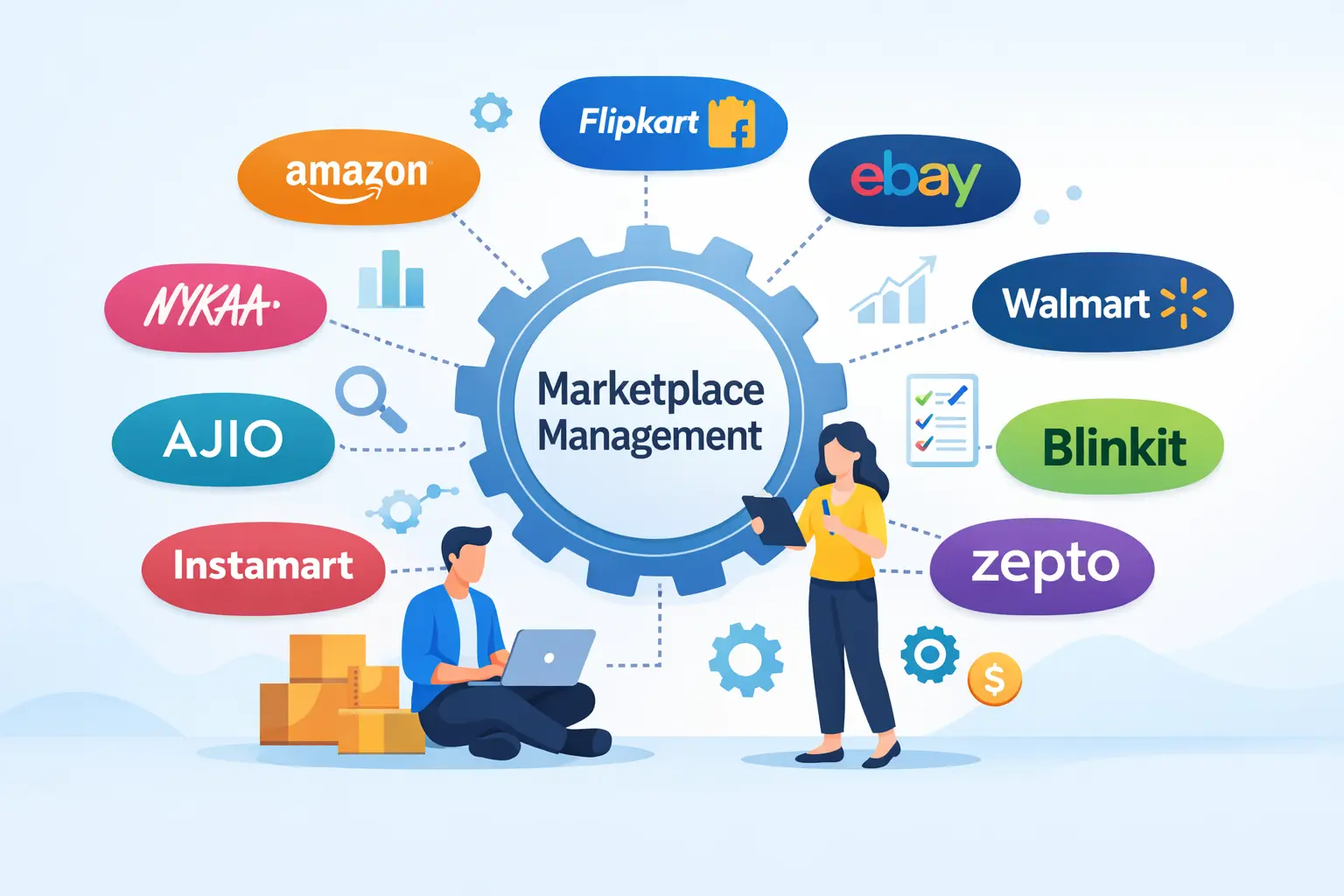
Every online marketplace works a little differently. Each platform attracts a different type of customer, follows its own rules, and requires a different way of managing products, pricing, delivery, and customer service. Some platforms are better for selling everyday products in large volumes, while others work well for branded or premium products. Understanding these differences helps sellers choose the right platforms and build realistic growth plans. This is also why many businesses sell on more than one marketplace to reach a wider audience and reduce dependency on a single platform.
Below is a region-wise overview of popular online marketplaces where sellers can start or expand their online presence.
Popular Marketplaces in India
India’s e-commerce market continues to grow rapidly, driven by increasing internet access, faster delivery networks, and growing trust in online payments. Customers shop online for everything from daily essentials and fashion to beauty products and electronics. Buying decisions are often influenced by pricing, delivery speed, reviews, and ease of returns. For sellers, success depends on choosing the right platforms, managing operations efficiently, and maintaining consistent service quality.
Below are some of the most widely used online marketplaces in India and how they work for sellers.
Amazon India
Amazon India is one of the largest e-commerce marketplaces in the country, giving sellers access to millions of customers across almost every product category.
Most buyers choose Amazon because of:
- Fast and reliable delivery
- Competitive pricing
- Easy return policies
- Trusted customer reviews and ratings
For sellers, this also means intense competition, with many similar products competing for visibility.
To stay competitive, sellers must:
- Optimize product listings continuously
- Monitor pricing closely
- Run advertising campaigns strategically
- Maintain strong delivery and fulfillment performance
- Actively collect and manage positive customer reviews
Even small errors in inventory planning, pricing, or listing quality can quickly impact visibility and sales performance.
Amazon works best for sellers who:
- Want to scale high-volume sales
- Operate with performance discipline
- Follow structured operational and optimization processes
To ensure steady growth in such a competitive environment, structured operational support through an Amazon Account Management Service helps sellers maintain listing quality, pricing control, inventory accuracy, advertising efficiency, and performance visibility, making long-term scaling more predictable and manageable.
Flipkart
Flipkart is one of India’s leading e-commerce platforms with a strong reach across Tier-2 and Tier-3 cities, making it ideal for mass-market distribution.
Customers typically shop on Flipkart for:
- Value-driven pricing
- Festive and seasonal offers
- Reliable and trusted sellers
- Wide product availability across electronics, home products, fashion, and daily essentials
For sellers, success on Flipkart requires:
- Competitive and dynamic pricing strategies
- Accurate and well-maintained product catalogs
- Consistent order fulfillment and inventory availability
Key performance metrics that directly impact visibility and sales include:
- Seller ratings and reviews
- Delivery speed and fulfillment accuracy
- Cancellation and return rates
- Customer feedback quality
Promotions, discounts, and platform-led sales events play a major role in driving volume, especially during high-traffic festive periods.
Flipkart works best for sellers who:
- Target mass-market demand
- Focus on volume-driven growth
- Can operate efficiently at scale with tight operational discipline
Maintaining catalog quality, inventory accuracy, and operational efficiency helps sellers remain competitive and avoid sudden performance drops during peak seasons. A focused Flipkart Account Management Service supports sellers in maintaining catalog health, managing promotions effectively, and keeping performance metrics aligned with long-term growth goals.
Nykaa
Nykaa specializes in beauty, skincare, wellness, fashion and personal care products, attracting highly informed and research-driven customers.
Customers typically:
- Research products carefully before purchasing
- Read customer reviews and ratings
- Compare ingredients, formulations, and benefits
- Trust influencer recommendations and brand credibility
For sellers, product presentation and content quality are critical for conversion, including:
- High-quality product images and visual consistency
- Detailed and accurate product descriptions
- Ingredient transparency and compliance
- Consistent pricing across channels
- Genuine and well-managed customer reviews
Nykaa follows strict onboarding, catalog quality, and content guidelines to maintain product authenticity and platform standards.
Success on Nykaa depends on:
- Strong brand positioning and storytelling
- Trust-building through consistent product quality and reviews
- Long-term brand investment rather than short-term discounting
Nykaa works best for brands that:
- Focus on premium positioning
- Prioritize credibility and customer trust
- Aim for sustainable brand building over aggressive price competition
To maintain content consistency, regulatory compliance, and strong brand visibility, a dedicated Nykaa Account Management Service helps sellers manage catalog standards, campaign visibility, inventory coordination, and platform guidelines more efficiently.
AJIO
AJIO is a fashion-focused marketplace catering to apparel, footwear, and lifestyle categories, attracting style-conscious and trend-driven shoppers.
Customers typically visit AJIO to:
- Explore trendy designs and seasonal collections
- Discover branded and private label assortments
- Browse curated fashion selections and style-led catalogs
For sellers, consistent operational excellence is essential, including:
- Accurate sizing charts and fit information
- Strong visual presentation and high-quality product imagery
- Reliable inventory availability and stock accuracy
- Timely order processing and fulfillment
Fashion demand changes rapidly, making the following critical for sustained growth:
- Regular catalog refresh and trend alignment
- Seasonal assortment planning
- Efficient returns and exchange management
- Inventory lifecycle optimization
Performance on AJIO depends on maintaining:
- Strong catalog hygiene and visual consistency
- Stable service metrics and delivery reliability
- Positive customer experience and repeat engagement
AJIO works best for brands that:
- Operate in fast-moving fashion categories
- Want to build brand visibility and repeat customers
- Focus on long-term assortment and demand planning
To manage frequent catalog updates, seasonal inventory cycles, and operational alignment effectively, an experienced AJIO Account Management Service helps sellers maintain listing quality, inventory planning discipline, and consistent marketplace performance.
Blinkit
Blinkit is a quick-commerce platform focused on ultra-fast delivery of daily essentials such as groceries, snacks, beverages, and household items.
Customers choose Blinkit primarily for:
- Instant delivery within minutes
- High product availability and convenience
- Everyday consumption needs and emergency purchases
For sellers, operational accuracy is critical, including:
- Real-time inventory accuracy at local fulfillment centers
- Frequent stock replenishment cycles
- Strong coordination with dark stores and micro-warehouses
Even small inventory mismatches can result in:
- Lost sales opportunities
- Order cancellations or penalties
- Reduced platform performance scores
Sustained performance on Blinkit requires:
- Accurate demand forecasting
- Tight supply chain coordination
- High service reliability and stock consistency
Blinkit works best for businesses that:
- Operate in fast-moving consumer goods (FMCG) categories
- Can handle high-frequency replenishment efficiently
- Maintain strong operational discipline and supply planning
In a real-time inventory environment like Blinkit, structured support through Blinkit Account Management Services helps sellers improve stock visibility, replenishment accuracy, operational coordination, and delivery consistency across high-demand service zones.
Zepto
Zepto Operates in the quick-commerce segment with a strong focus on extremely fast delivery in urban and metro locations.
Customers typically prioritize:
- Speed and instant fulfillment
- Convenience and accessibility
- High product availability
- Minimal browsing and limited price comparison
For sellers, operational efficiency matters more than brand positioning, including:
- High stock accuracy across fulfillment points
- Rapid replenishment cycles and inventory turnover
- Smooth supply chain coordination to avoid service disruptions
Margin control is critical because quick-commerce platforms operate on tight pricing and commission structures.
Sustained success on Zepto depends on:
- Predictable demand planning
- Tight operational execution
- Strong replenishment discipline
- Low fulfillment error rates
Zepto works best for sellers who:
- Handle high-turnover products
- Operate with stable and predictable demand patterns
- Can scale operations efficiently in dense urban markets
With frequent order cycles and tight execution timelines, professional Zepto Account Management Services support sellers in optimizing inventory flow, replenishment planning, operational consistency, and performance monitoring to maintain predictable growth.
Instamart
Instamart, operated by Swiggy, serves customers who want groceries and daily essentials delivered quickly within Swiggy’s delivery ecosystem.
Customers typically expect:
- Reliable product availability
- Consistent product quality
- Fast and dependable fulfillment
- Seamless app-based ordering experience
For sellers, operational consistency is critical, including:
- Stable and predictable supply availability
- Accurate real-time inventory feeds
- High packaging quality to prevent damage and returns
- Strong coordination with fulfillment and delivery partners
Product availability directly impacts:
- Platform visibility
- Order volumes
- Repeat customer purchases
Smooth operations depend on:
- Tight integration with Swiggy’s fulfillment network
- Low order discrepancy and delivery issue rates
- Strong demand forecasting and replenishment planning
Instamart works best for sellers who:
- Maintain reliable supply chains
- Operate with predictable demand cycles
- Can sustain consistent service quality at scale
To maintain stable fulfillment performance and inventory accuracy at scale, Instamart Account Management Services helps sellers streamline operational workflows, monitor performance indicators, and improve long-term service reliability across delivery zones.
Popular Marketplaces in the United States
The United States has one of the most mature and competitive e-commerce markets in the world. Customers expect fast delivery, accurate product information, dependable customer service, and seamless returns. Buyers often compare prices, read reviews carefully, and prefer platforms that offer consistent reliability. For sellers, maintaining strong operational discipline, efficient fulfillment, and continuous performance optimization is essential for building sustainable growth.
Amazon US
Amazon US operates at a massive national scale, serving customers who expect high service standards across multiple product categories such as electronics, home goods, beauty, and daily essentials.
Customers typically expect:
- Fast and reliable shipping
- Accurate and detailed product information
- Consistent service quality and delivery experience
- Strong brand trust and platform reliability
For sellers, competition is extremely intense due to:
- Multiple sellers competing for the same product visibility
- Price sensitivity and constant competitive benchmarking
- High dependency on advertising for discoverability
To remain competitive, sellers must continuously optimize:
- Pricing strategies and margin control
- Listing quality, content accuracy, and SEO
- Inventory planning and stock availability
- Advertising performance and campaign efficiency
- Review generation and reputation management
Even minor operational issues, such as stock shortages, delayed shipments, or listing error,s can quickly impact:
- Search rankings and visibility
- Buy Box ownership
- Sales velocity and revenue consistency
Amazon US works best for sellers who:
- Want to scale nationally and capture a large market share
- Build long-term, volume-driven businesses
- Operate with disciplined operational systems and performance tracking
In such a high-velocity environment, structured support through an Amazon Account Management Service helps sellers maintain listing accuracy, pricing stability, inventory health, advertising efficiency, and performance tracking, enabling more predictable scaling and operational control.
Walmart Marketplace
Walmart Marketplace serves a large base of retail-focused customers across the United States, with strong trust in brand reliability and fulfillment consistency.
Customers typically expect:
- Reliable and on-time delivery
- Authentic products and verified quality standards
- Consistent pricing and product availability
- Strong trust in Walmart’s retail reputation
Walmart is especially strong in categories such as:
- Household essentials and consumables
- Electronics and accessories
- Everyday consumer products
For sellers, Walmart enforces strict operational and compliance standards, including:
- High order accuracy and low cancellation rates
- Consistent inventory availability
- On-time shipping performance
- Full adherence to platform policies and seller guidelines
Performance issues or repeated policy violations can directly impact:
- Account health scores
- Product visibility and Buy Box eligibility
- Long-term seller approval and growth potential
Walmart Marketplace works best for sellers who:
- Operate with strong operational discipline
- Maintain stable and reliable supply chains
- Deliver consistent fulfillment performance at scale
To maintain performance consistency and compliance at scale, Walmart Seller Account Management Services supports sellers in monitoring account health, improving operational execution, maintaining inventory accuracy, and aligning performance metrics with platform requirements.
eBay USA
eBay in the USA is widely used in the US as a high-volume marketplace supporting both bulk buying and individual purchases.
Buyers actively shop for:
- New, used, refurbished, and open-box products
- Electronics, automotive parts, tools, collectibles, fashion, and home goods
- Competitive deals and price comparisons
- Discontinued, rare, or hard-to-find items
eBay attracts value-conscious customers including:
- Bulk buyers
- Resellers and arbitrage sellers
- Deal hunters and bargain-focused shoppers
Many US sellers use eBay to:
- Move excess or slow-moving inventory
- Liquidate returns and refurbished stock
- Test new product categories and niches
- Scale specialized product lines efficiently
Competition is strong in popular categories, making the following critical for success:
- Accurate and optimized product data
- Competitive pricing strategies
- Fast and reliable shipping performance
- Strong seller ratings and feedback management
- Consistent customer service quality
Sustained performance at scale requires:
- Structured inventory management
- Operational process discipline
- Continuous listing and pricing optimization
Our eBay Seller Account Management Services support US sellers with listing optimization, pricing strategy, performance tracking, order management, and operational scalability so you can grow sustainably while maintaining marketplace compliance.
Popular Marketplaces in the United Kingdom
The United Kingdom has a well-established online retail market with high customer expectations around delivery speed, product accuracy, and post-purchase support. Buyers actively compare prices, read reviews, and prefer sellers who offer reliable service and transparent policies. For sellers, maintaining consistent operational performance and strong fulfillment standards plays a key role in sustaining visibility and long-term growth.
Amazon UK
Amazon UK serves a large online shopping audience across multiple product categories, including electronics, fashion, home goods, beauty, and everyday essentials.
Customers typically expect:
- Fast and reliable delivery
- Accurate and detailed product information
- Easy and hassle-free returns
- Consistent service quality and fulfillment standards
For sellers, competition remains strong, making the following essential for visibility and growth:
- Competitive pricing and margin control
- High-quality product listings and optimized content
- Reliable fulfillment performance and delivery accuracy
- Strong seller ratings and customer feedback management
Advertising is frequently required to maintain discoverability, especially in highly competitive categories.
Inventory accuracy and delivery timelines directly impact:
- Seller ratings and customer trust
- Account health and long-term visibility
- Buy Box performance and conversion rates
Amazon UK works best for sellers who:
- Aim to build national market reach
- Operate with scalable systems and automation
- Maintain strong operational discipline and performance tracking
To maintain consistent visibility and operational control in such a competitive environment, structured support through an Amazon Account Management Service helps sellers optimize listings, manage inventory accuracy, improve advertising efficiency, and monitor performance trends for sustainable growth.
eBay UK
eBay UK is a highly trusted marketplace for both brand-new and pre-owned products.
Buyers actively shop for:
- Refurbished electronics
- Fashion and home accessories
- Spare parts and collectibles
- Value-driven pricing and flexible product conditions
UK buyers value:
- Competitive pricing
- Fast domestic delivery
- Transparent seller ratings and reviews
- Clear product condition disclosures
UK sellers commonly use eBay to:
- Clear seasonal stock and surplus inventory
- Reach budget-driven and value-conscious consumers
- Serve bulk buyers and trade resellers
- Maintain flexible pricing strategies across categories
To remain competitive, sellers must consistently maintain:
- Accurate and optimized product listings
- Strong feedback and seller performance scores
- Responsive customer communication
- Efficient order fulfillment and dispatch timelines
- Structured returns management processes
Service quality and return handling directly impact:
- Long-term account health
- Search visibility and conversion performance
- Buyer trust and repeat purchase rates
Our eBay Seller Account Management Services help UK sellers streamline daily operations, optimize listings for higher conversion, manage inventory efficiently, and improve overall marketplace performance.
Popular Marketplaces in Europe
Europe operates as a multi-country e-commerce ecosystem, where each market follows its own language preferences, tax regulations, delivery networks, and customer expectations. Buyers value accurate local listings, transparent pricing, reliable delivery, and consistent post-purchase support. For sellers, expanding across Europe requires careful planning around localization, compliance, and cross-border operations to ensure smooth scaling.
Amazon Europe
Amazon operates localized marketplaces across Germany, France, Italy, Spain, and several other European countries, allowing sellers to reach multiple regions from a single platform.
Customers typically expect:
- Localized product information and language support
- Reliable and predictable delivery timelines
- Consistent service standards across countries
- Transparent pricing and tax compliance
Sellers expanding across Amazon Europe must manage:
- Multilingual product listings and localized content
- VAT registration and ongoing tax compliance
- Regional pricing strategies and currency alignment
- Inventory distribution across fulfillment centers
- Cross-border shipping and fulfillment coordination
Operational complexity increases as sellers scale into multiple European markets simultaneously.
Strong coordination and compliance are essential to avoid:
- Regulatory penalties
- Fulfillment delays and customer dissatisfaction
- Account performance risks
Amazon Europe works best for brands that:
- Are expanding internationally
- Have structured operational readiness
- Maintain scalable logistics and compliance systems
To maintain operational clarity across multiple regions, structured support through an Amazon Account Management Service helps sellers manage localized listings, inventory coordination, regulatory compliance, advertising performance, and performance tracking while scaling efficiently across European markets.
eBay Europe
eBay operates as a multi-marketplace platform across Europe, supporting cross-border buyers and regional demand across diverse product categories.
European buyers actively look for:
- Authentic and verified products
- Clear product specifications and condition transparency
- Reliable delivery timelines
- Transparent return and refund policies
High-demand categories across Europe include:
- Electronics and refurbished devices
- Automotive parts and accessories
- Collectibles and niche products
- Specialized and hard-to-find inventory
Sellers commonly use eBay Europe to:
- Expand reach across multiple countries
- Liquidate slow-moving or excess stock
- Serve specialized buyer communities
- Test cross-border demand for new categories
Pricing sensitivity varies by region, making the following essential:
- Dynamic pricing strategies
- Localized listing optimization
- Regional competitiveness monitoring
Operational complexity increases due to:
- Language variations and localization requirements
- VAT compliance and regional tax obligations
- Cross-border shipping and logistics coordination
- Different customer service expectations by country
Scalable growth requires:
- Strong catalog management systems
- Structured fulfillment workflows
- Consistent customer experience standards
Our eBay Seller Account Management Services support European sellers with multi-market optimization, listing standardization, pricing strategy, operational process alignment, and performance monitoring to ensure sustainable cross-region growth.
Popular Marketplaces in Australia
Australia’s e-commerce market continues to grow steadily as more consumers shift toward online shopping for electronics, lifestyle products, home goods, and everyday essentials. Customers value reliable delivery, product authenticity, clear product information, and consistent service quality. For sellers, maintaining inventory availability and dependable fulfillment plays a key role in building long-term trust and repeat purchases.
Amazon Australia
Amazon Australia is a growing marketplace with increasing customer adoption and relatively lower competition compared to mature global markets.
Customers typically expect:
- Competitive pricing across key product categories
- Reliable and predictable delivery timelines
- Accurate and detailed product information
- Consistent service quality and fulfillment reliability
For sellers, the market offers:
- Early-stage growth opportunities
- Faster visibility compared to saturated marketplaces
- Lower initial competitive pressure
As competition gradually increases, sellers must maintain:
- Consistent inventory availability
- Strong fulfillment performance and delivery accuracy
- High-quality and optimized product listings
- Pricing discipline and margin control
Listing quality, pricing strategy, and delivery reliability directly influence:
- Product visibility and discoverability
- Customer trust and repeat purchases
- Long-term brand positioning
Amazon Australia works best for sellers who:
- Are you entering international markets strategically
- Follow controlled expansion models
- Operate with scalable operational planning and systems
To maintain structured growth while building marketplace presence, leveraging an Amazon Account Management Service helps sellers manage listing quality, inventory planning, advertising optimization, and ongoing performance monitoring more efficiently.
eBay Australia
eBay is a dominant marketplace in Australia for competitively priced products across multiple categories.
High-demand categories include:
- Electronics and refurbished devices
- Automotive accessories and tools
- Lifestyle goods and home categories
- Collectibles and niche inventory
Australian buyers value:
- Strong product availability
- Competitive pricing
- Reliable delivery timelines
- Access to both local and imported inventory
Australian sellers commonly use eBay to:
- Reach buyers nationwide
- Clear overstock and surplus inventory
- Sell refurbished and secondary-condition products
- Serve niche demand where traditional retail availability is limited
- Supply bulk buyers and small businesses
Success on eBay Australia depends on:
- Accurate and optimized product listings
- Reliable fulfillment and dispatch performance
- Responsive customer communication and support
- Strong seller ratings and feedback management
Logistics and inventory planning are especially critical due to:
- Large geographic distances
- Delivery timeline expectations
- National distribution complexity
Our eBay Seller Account Management Services help Australian sellers optimize product visibility, streamline order processing, improve account performance, and scale operations with confidence.
Popular Marketplaces in the Middle East
The Middle East e-commerce market continues to grow rapidly as digital adoption increases, logistics infrastructure improves, and customers gain stronger confidence in online shopping. Buyers value fast delivery, competitive pricing, product authenticity, and reliable customer service. For sellers, understanding regional regulations, localized fulfillment requirements, and customer expectations is essential for building sustainable growth.
Amazon Middle East (UAE / Saudi Arabia)
Amazon UAE and Saudi Arabia operate localized platforms supported by growing Prime adoption and expanding logistics infrastructure.
Customers typically use Amazon for:
- Dependable and timely delivery
- Wide product selection across major categories
- Consistent service standards and platform reliability
- Trusted fulfillment and customer experience
Strong demand exists across categories such as:
- Electronics and accessories
- Fashion and lifestyle products
- Home goods and appliances
- Daily essentials and consumables
For sellers, operating in the region requires careful management of:
- Import regulations and customs compliance
- Product certification and regional compliance standards
- Localized pricing and currency management
- Tax structures and regulatory requirements
- Fulfillment performance and delivery accuracy
Key performance drivers include:
- Reliable delivery timelines
- Accurate product information and catalog quality
- Strong seller ratings and customer feedback
- Consistent service execution
Amazon Middle East works best for sellers who:
- Target GCC markets strategically
- Have structured logistics and supply chain planning
- Maintain strong regional compliance readiness
To maintain operational clarity and consistent execution across regional marketplaces, structured support through an Amazon Account Management Service helps sellers manage localized listings, inventory coordination, advertising optimization, regulatory alignment, and performance monitoring for scalable growth.
Why This Matters for Sellers?
Each marketplace has its own buyer behavior, pricing expectations, logistics model, and compliance rules. Using the same strategy everywhere often leads to inefficiencies and mistakes. As sellers expand to multiple platforms, structured online marketplace management and multi-marketplace management systems help maintain operational consistency, reduce errors, and scale profitably.
To make the differences easier to understand at a glance, here’s a quick comparison of the most popular online marketplaces and what sellers should prioritize on each platform:
Why Multi-Marketplace Management Matters?
- Each marketplace operates differently, so a strategy that works on one platform may not perform well on another without customization.
- Managing everything manually increases the chance of pricing errors, inventory mismatches, and compliance issues.
- Centralized systems allow sellers to monitor performance, inventory, and pricing across all platforms from one dashboard.
- Structured multi-marketplace management makes it easier to expand into new platforms without operational chaos.
What Does End-to-End Marketplace Management Include?
End-to-end marketplace management covers the entire lifecycle of marketplace operations:
- Account setup ensures all legal, tax, and policy requirements are completed correctly so the business can operate smoothly from day one.
- Product listings are optimized for better visibility and higher conversions by using relevant keywords, images, and structured content.
- Inventory and fulfillment planning help maintain consistent stock availability and timely deliveries.
- Advertising campaigns are designed to increase visibility while maintaining healthy profitability.
- Pricing and competitor monitoring help sellers stay competitive without sacrificing margins.
- Customer experience management improves reviews, ratings, and long-term customer trust.
- Performance analytics provide clear insights into sales trends, costs, and growth opportunities.
Who Should Use Marketplace Management Services?
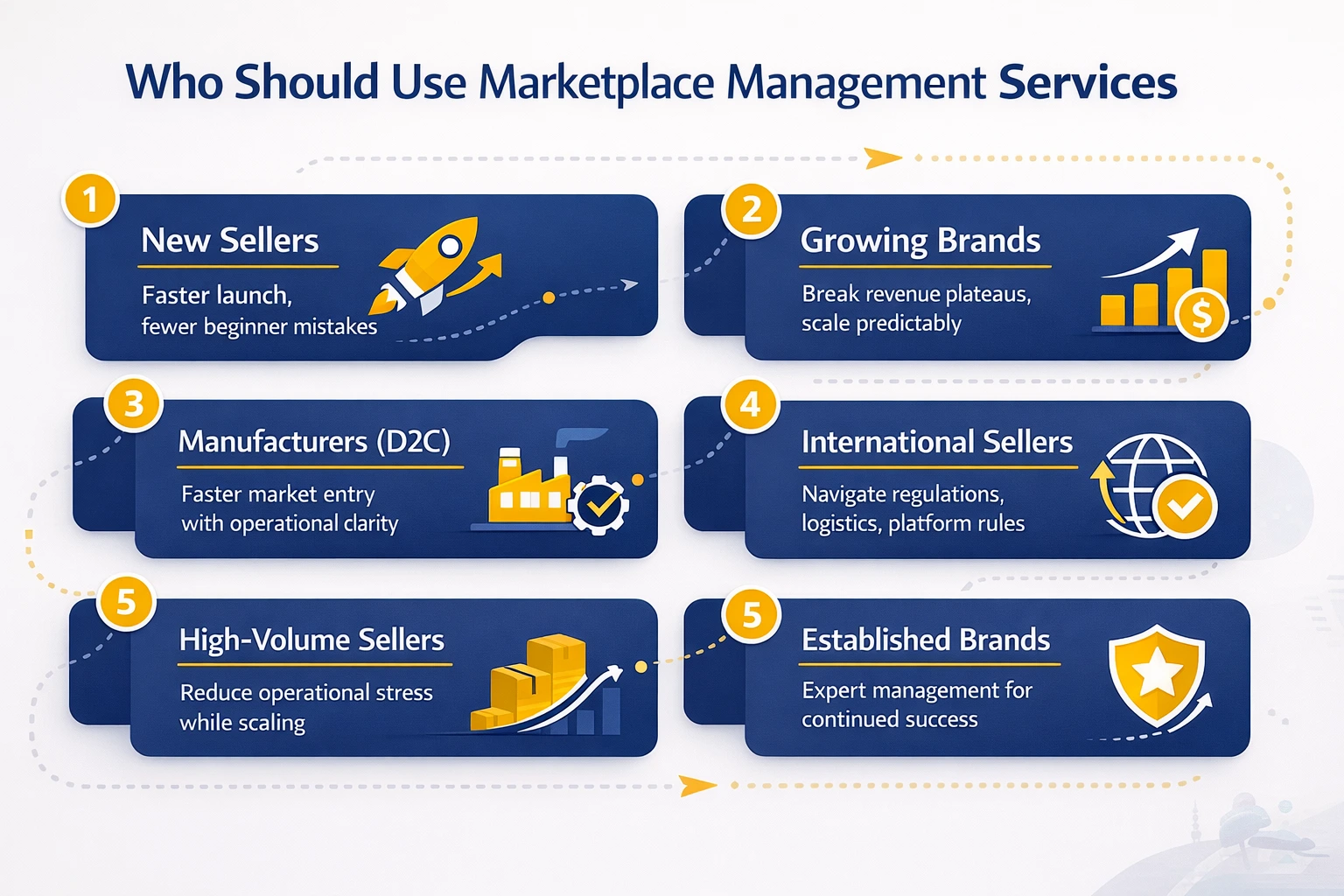
- New sellers benefit by avoiding common beginner mistakes and launching faster with professional guidance.
- Growing brands use structured management to break revenue plateaus and scale predictably.
- Manufacturers entering direct-to-consumer selling gain operational clarity and faster market entry.
- International sellers receive support navigating regulations, logistics, and platform requirements.
- High-volume sellers reduce operational stress while maintaining control over expanding operations.
How to Choose the Right Marketplace Management Company?
- Look for a team with proven marketplace experience so they understand real-world challenges and platform dynamics.
- Transparent reporting ensures you always know how your investment is performing and where improvements are needed.
- Automation-driven workflows improve speed, accuracy, and scalability.
- Advertising expertise helps control rising ad costs and maximize return on spend.
- Strong compliance knowledge protects your seller account from penalties or suspensions.
- Dedicated account support ensures accountability and faster problem resolution.
Common Mistakes Sellers Make Without Professional Support
- Inventory mismanagement: Failing to properly track inventory can lead to stockouts or overstocking. Both of these can negatively affect sales. Stockouts frustrate customers who cannot purchase desired items, while overstocking ties up capital and incurs unnecessary storage costs.
- Policy violations: Each online marketplace has strict rules and guidelines. Violating these policies, whether due to listing inaccuracies, prohibited content, or non-compliance with terms, can result in penalties, including listing suppression or even account suspension. This severely impacts your business operations.
- Inefficient ad spending: Without a clear strategy, ad budgets can be wasted on ineffective campaigns, leading to high costs without generating the desired return on investment. It is crucial to target the right audience and use optimized ad creatives to maximize ad spend.
- Slow review growth: Customer reviews play a critical role in building trust and improving conversion rates. Without a steady stream of positive reviews, potential buyers may hesitate, feeling uncertain about the product’s quality or the brand’s reliability.
- Pricing errors: Incorrect pricing, whether too high or too low, can hurt your business. Overpricing can push customers toward competitors, while underpricing may lead to low margins and missed revenue opportunities. Proper pricing strategies ensure competitiveness while safeguarding profitability.
Marketplace Account Management vs Full-Service Marketplace Account Management
Marketplace account management usually focuses on operational execution, while full-service marketplace management focuses on growth strategy, profitability optimization, and scalable systems.
Benefits of Professional Marketplace Seller Management
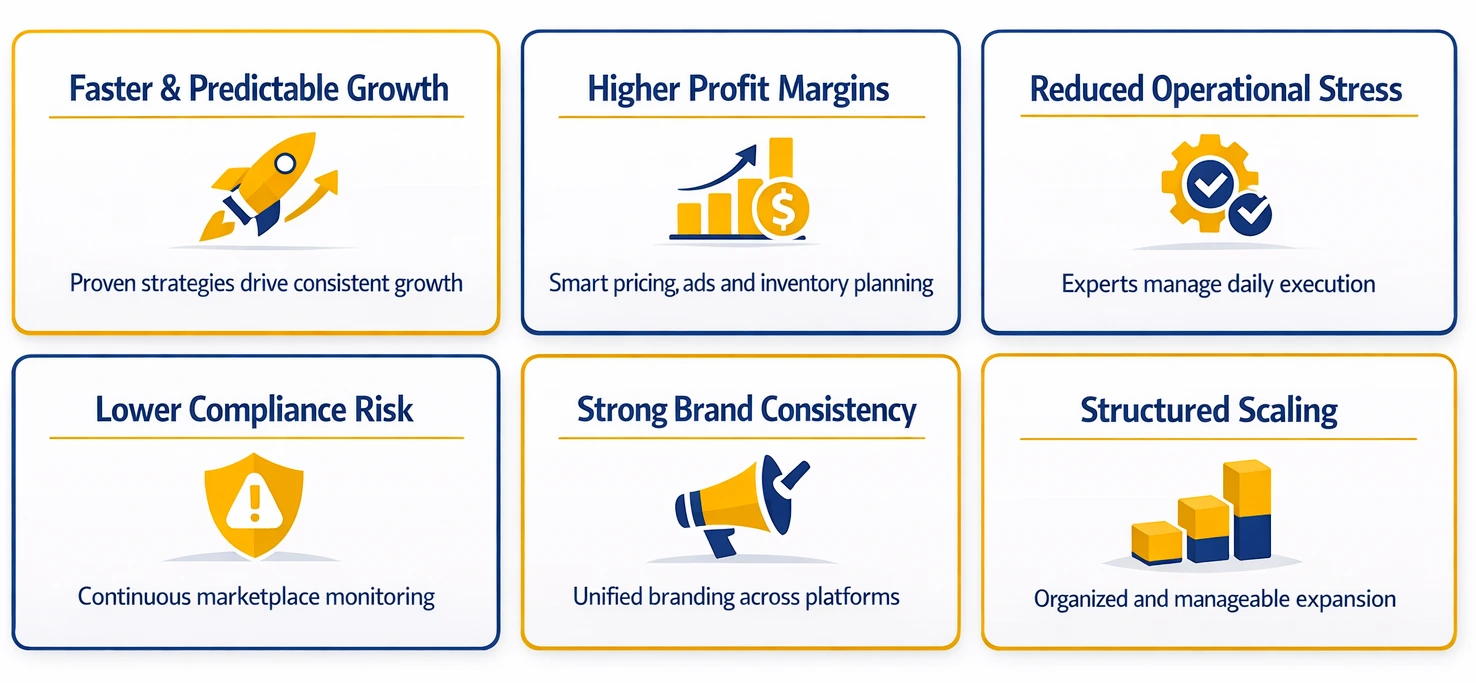
- Sellers achieve faster and more predictable growth: Professional management helps sellers grow quickly and consistently by using proven strategies and insights.
- Profit margins improve: Smarter pricing, ad optimization, and inventory planning lead to higher profit margins.
- Daily operational stress reduces: Experts handle execution, easing the operational burden on sellers.
- Compliance risks are minimized: Continuous monitoring ensures adherence to marketplace rules, reducing the risk of penalties.
- Brand consistency improves: Experts maintain consistent branding across platforms, fostering long-term trust with customers.
- Scaling becomes structured and manageable: With professional support, scaling is organized and less chaotic.
Pricing Models for Marketplace Management Services
The cost of marketplace management services can vary widely depending on the size of your business, the number of marketplaces you sell on, the complexity of your operations, and the level of support you need. There is no one fixed price, because every seller’s requirements are different.
Most marketplace management companies follow one of three common pricing models:
Monthly Retainer Model:
In this model, you pay a fixed monthly fee for ongoing management of your marketplace accounts. This usually covers listing optimization, inventory monitoring, ad management, reporting, and daily operational support. Retainers work well for brands that want predictable monthly expenses and consistent long-term support.
Revenue-Based or Performance Model:
Here, the service provider charges a percentage of the revenue generated or the growth achieved. This model aligns incentives because the agency benefits when your sales increase. However, it can become more expensive as your business scales, so it’s important to clearly define what performance metrics are included.
Hybrid Model:
Some companies combine both approaches — a smaller fixed retainer plus a performance-based component. This balances stability for the service provider while keeping growth incentives aligned.
When evaluating pricing, it’s important to focus not just on the cost, but on the return on investment. A good marketplace management partner should help increase sales, improve margins, reduce operational errors, and free up your internal team’s time. The real value comes from long-term scalability, profitability, and reduced business risk — not just short-term cost savings.
Final Thoughts
The future of e-commerce belongs to sellers who operate with systems, data, and strategy – not manual processes. Professional marketplace management services enable brands to scale confidently across platforms while maintaining control over profitability and customer experience.
If you’re serious about building a sustainable online business, investing in structured online marketplace management is a long-term competitive advantage.
Frequently Asked Questions
Q: What are the 4 types of e-commerce?
The four types of e-commerce are B2C (business to consumer), B2B (business to business), C2C (consumer to consumer), and D2C (direct to consumer).
Q: What are the benefits of online marketplaces?
Online marketplaces offer wider customer reach, built-in trust, faster sales growth, lower setup costs, and access to established logistics and payment systems.
Q: Which platform is best for online selling?
The best platform depends on your product category, target market, pricing strategy, and fulfillment capability. Amazon, Flipkart, and Nykaa suit different seller goals.
Q: Which category is best to sell online?
High-demand categories include fashion, beauty, electronics, home essentials, groceries, and health products, depending on competition, margins, and supply reliability.
Q: What is seller management?
Seller management involves managing account performance, listings, pricing, inventory, customer service, compliance, and growth optimization for marketplace sellers.
Q: What is end-to-end service management?
End-to-end service management means handling the complete business lifecycle, from setup and operations to optimization, reporting, and continuous improvement.